
The Challenge of Creating Schools That Are Rooted in the Local Area
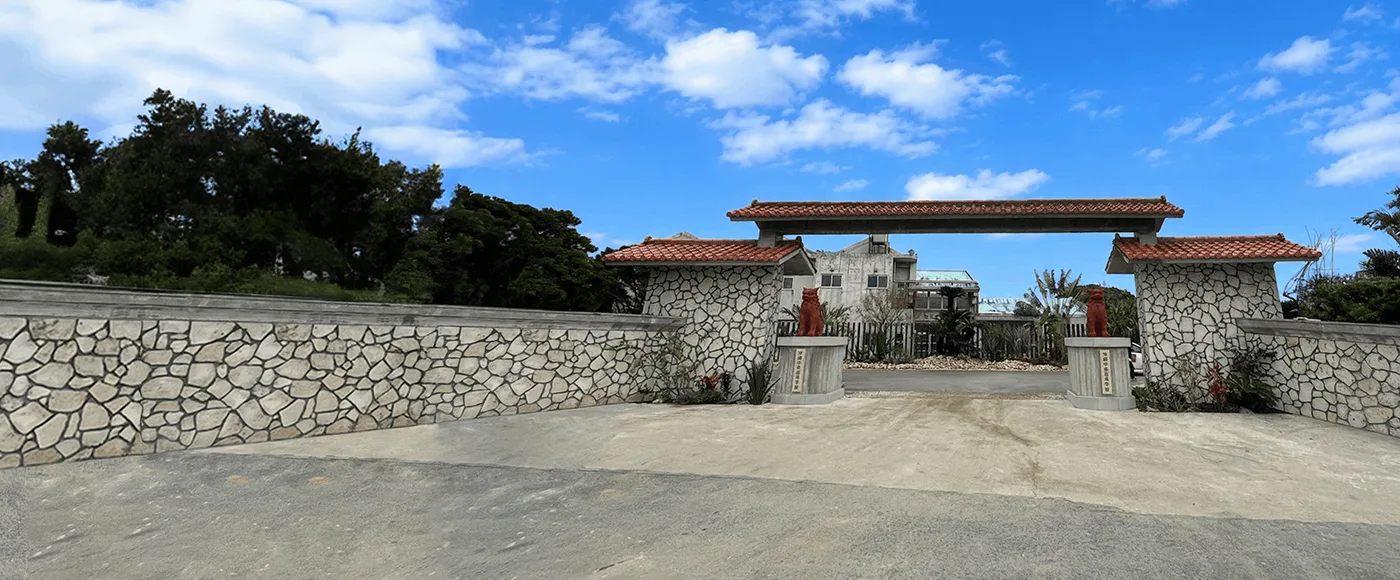
Reviving Shuttered Schools and Transforming Them Into Community‑Linked Learning Spaces
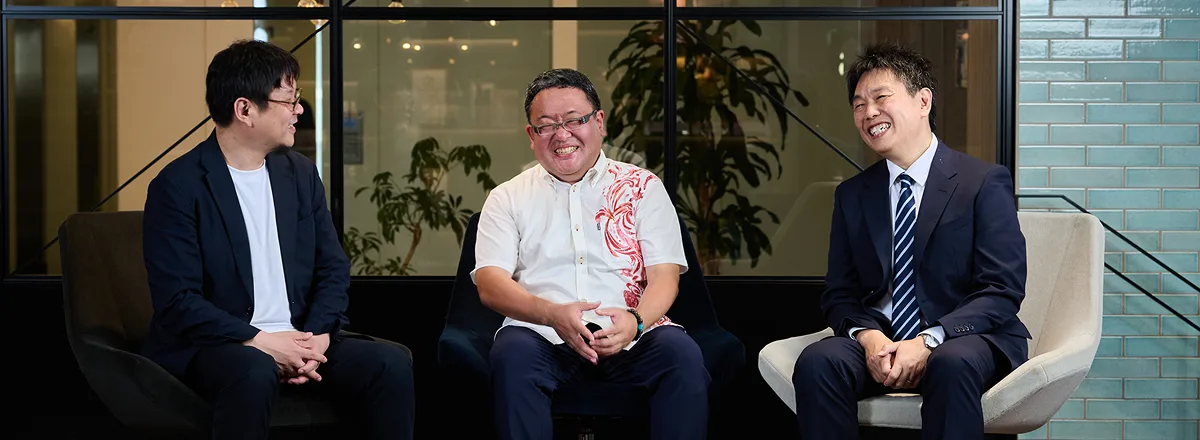
The PLUS Group's Institute of Educational Environment has been involved in numerous school construction projects and is continually proposing concepts for new learning spaces. PLUS Corporation's Furniture Company also shares new ideas for educational environments through its school furniture supply activities. One of the PLUS Group's material priorities is “Promoting partnerships with local communities.” As part of that commitment, we assisted with the development of Okinawa Chuo High School, which opened in October 2025 as a wide‑area correspondence school. We asked three of the people involved in that project to talk about their experiences.
Profiles
Kazunori Hirose
Deputy Director and Senior Researcher
Institute of Educational Environment
Kazunori Hirose joined PLUS Corporation in 2002. Currently assigned to the Institute of Educational Environment, he is involved in both research and practical work in the field of school architecture. Mr. Hirose participates in school development projects throughout Japan, with a particular focus on elementary and junior high schools. He provides direction throughout the planning, design, and construction phases of these projects.
Shogo Moriya
Kyushu Office, Sales Headquarters, Furniture Company, PLUS Corporation
After joining PLUS Corporation in 2016, Shogo Moriya was assigned to the JOINTEX Company, where he managed office supply sales. In 2022, he transferred to the Furniture Company, where he is involved in the proposal and supply of furniture products. He is also responsible for managing public sector projects.
Yosuke Oka
Kanto Office, Sales Headquarters, Furniture Company, PLUS Corporation
Yosuke Oka joined PLUS Corporation in 2018, and was assigned to the JOINTEX Company, where he was involved in sales of lifestyle products and office furniture. He transferred to the Furniture Company in 2022. His activities include office furniture sales and interior finishing projects.
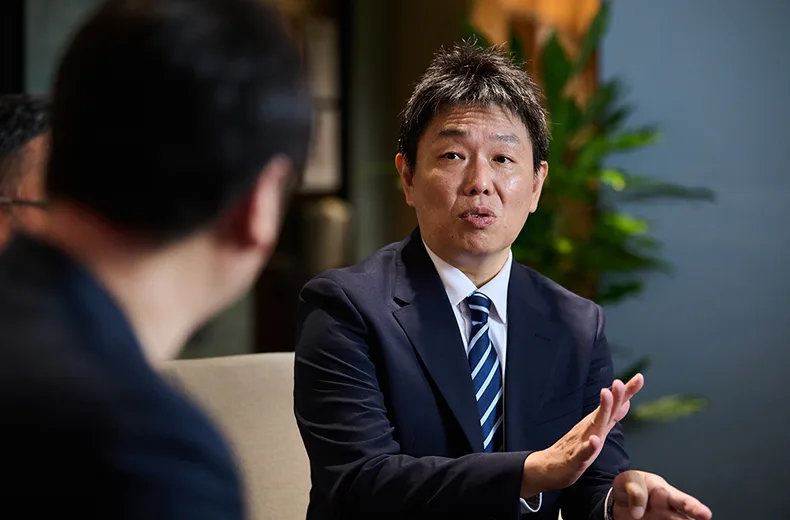
1. Project Background A shared passion for helping children acquire the skills needed to thrive in society
What led to your involvement in initiatives to support the establishment of Okinawa Chuo High School?
Our relationship with Chuo Kokusai Gakuen, the founder of Okinawa Chuo High School, began in 2013, when we collaborated on the establishment of a school corporation and Chuo Kokusai High School, a wide‑area correspondence high school based in Onjuku, Chiba Prefecture. In 2024, Chuo International Academy consulted us about the establishment of a second school. Their concept called for the use of a closed school in Miyakojima City, Okinawa Prefecture to establish a wide‑area correspondence high school with the capacity for up to 5,000 students. We provided comprehensive hands‑on support for the project, including the school establishment approval process, assistance with studies on how to utilize the closed school's facilities, and practical support for school operations.
Following the decision to open the second school, we asked to handle the procurement and delivery of furniture for the new school. However, because the new school would be established on an island in Okinawa, it would not have been practical to handle the entire process solely from the Kanto Office, where I was assigned at the time. I therefore approached Mr. Moriya at the Okinawa Office for advice.
Mr. Oka asked me to arrange local subcontractors and supervise on‑site delivery operations. When I saw the school building during the initial site survey, it became clear that the school was totally disused. While I had some concerns about whether it could really be restored, I was also intrigued and eager to see the facilities for myself.
2. School Development Concept Creating a school with a focus on local experiences and community connections
What were your priorities when creating the physical environment?
When selecting furniture for the school, we tried to harmonize designs with the Chuo Kokusai High School at Onjuku, while also incorporating Okinawan elements. Using the school color, green, as the base element, we also incorporated woodgrain bookshelves to create a décor attuned to Okinawa's tropical environment. We selected lounge and library corner furniture with the goal of creating relaxed environments. We also sought to create spaces that would encourage natural interactions between people by installing ping‑pong tables and other equipment.
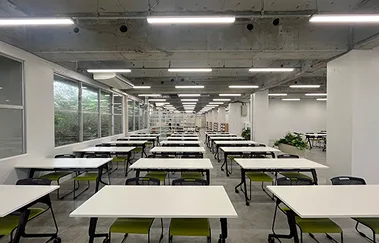
Partition‑free classroom spaces to allow flexible adjustment according to the number of students.
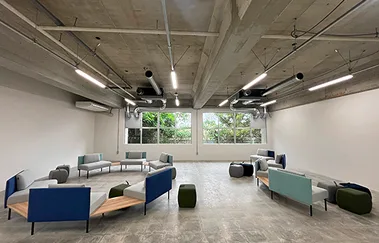
An open space designed for interactions in a relaxed setting.
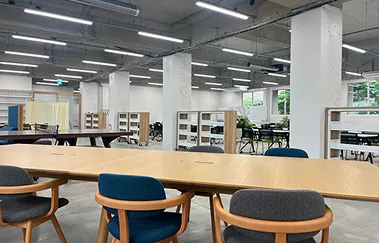
Extensive use of woodgrain furniture
What was your approach to partnering with local communities?
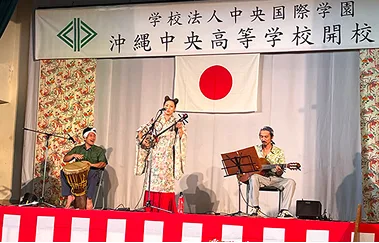
Okinawa Chuo High School emphasizes giving students authentic experiences, including interactions with local industries, such as agriculture, fishing, and tourism, as well as the region's natural environment and historical heritage. Particular priority is given to direct learning from and interactions with local residents. The new campus is located on the former site of Okinawa Prefectural Irabu High School. Many alumni still living on the island were deeply saddened by the school's closure. A key initiative going forward will be to open up the school's facilities for use in local community activities, and we have already created the baseline environment for that.
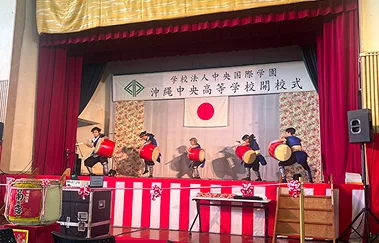
Local groups perform Eisa dancing and Sanshin music at the school's opening ceremony.
3. Preparations for the Project Our biggest project ever, with the additional challenge of working on a remote island
How did you approach a school development project in such a challenging location?
We faced multiple challenges at the start of this project. First, once it became clear that it would be possible to acquire the former Irabu High School site, we had to decide whether we should aim to open the new school as quickly as possible. The second challenge was that the old school buildings had been shuttered for many years. This meant that a certain amount of renovation design and repair work would be required, necessitating the selection of contractors to carry out this work. Third, we had to adopt a trial‑and‑error approach for the new school, since the guidelines for wide‑area correspondence high schools had been revised and were being more strictly enforced. By overcoming a variety of challenges, we were able to open the new school within the shortest possible timeline. This was the result of collaborative efforts by the entire project team, with our role being just one part of that work.
Starting around June 2024, PLUS began to finalize its proposals for furniture layouts and costs. However, estimating transportation costs and delivery schedules was a challenge because of the school's location on a remote island. Transportation times and costs as far as Naha were predictable, but the leg from Naha to the remote island presented a new set of difficulties. Nevertheless, we were able to develop a plan after receiving extensive input from Mr. Moriya about transportation times and costs.
One of the aspects that I discussed with Mr. Oka was the unique challenges of packaging disposal on a remote island. Since the PLUS Group did not have any construction teams based in Okinawa, we instead asked our distributor on mainland Okinawa and our distributor and subcontractors on Miyako Island to assist with this task. Deliveries began in August 2025. With the school scheduled to open on October 1, the time available for construction work was short at just under two months. I therefore took a personal role in the furniture assembly work in order to keep the project moving forward at a rapid pace. Despite the exhausting nature of this work in the middle of summer, we somehow managed to finish everything on schedule.
4. Insights from the Project Leveraging PLUS Group synergies in the education sector
How did you feel after completing such a socially significant project?
This was the largest project I've ever managed. While it was challenging, it also gave a major boost to my confidence. I would not have been able to complete the project without the assistance provided by many people, including my supervisor, who helped me to build relationships with distributors, as well as colleagues who helped me prepare quotes for products supplied to a remote island. As someone working at the Okinawa Sales Office, I'm very grateful for the opportunity to take part in a project that will contribute to the revitalization of the region.
I regard my participation in this project as a major personal achievement. I was able to gain experience and knowledge through a state‑of‑the‑art school facility development initiative. My experience of the project has greatly enhanced my sense of confidence, and I feel ready to take on any similar projects in the future.
Mr. Oka's decision to contact Mr. Moriya early in the project to discuss furniture planning and procurement within the PLUS Group was a wise move. This collaboration enabled us to take on a project on a remote Okinawan island, an area where we would normally not operate. We have continued to support the school's day‑to‑day activities by reliably supplying furniture and consumables. In addition to large‑scale initiatives, such as planning and construction, we also look forward to leveraging synergies across the PLUS Group to provide continuing support for school activities.
Okinawa Chuo High School utilizes an “intensive schooling*” program that provides diverse hands‑on experiences alongside academic learning. The program encompasses activities that go beyond simple classroom lessons and use the entire city of Miyakojima as a learning space. We therefore adopted a design that minimized the use of partitions, creating spaces capable of accommodating both small and large groups. We also aimed to create an open, relaxed environment for these intensive schooling sessions.
Intensive schooling: A program where students physically attend classes at the school over multiple days.